Which Toothpaste Is Best for Whitening Teeth?

Dental Implant vs Crown: What’s the Difference?
February 13, 2025
Do Teeth Whitening Trays Work?
February 20, 2025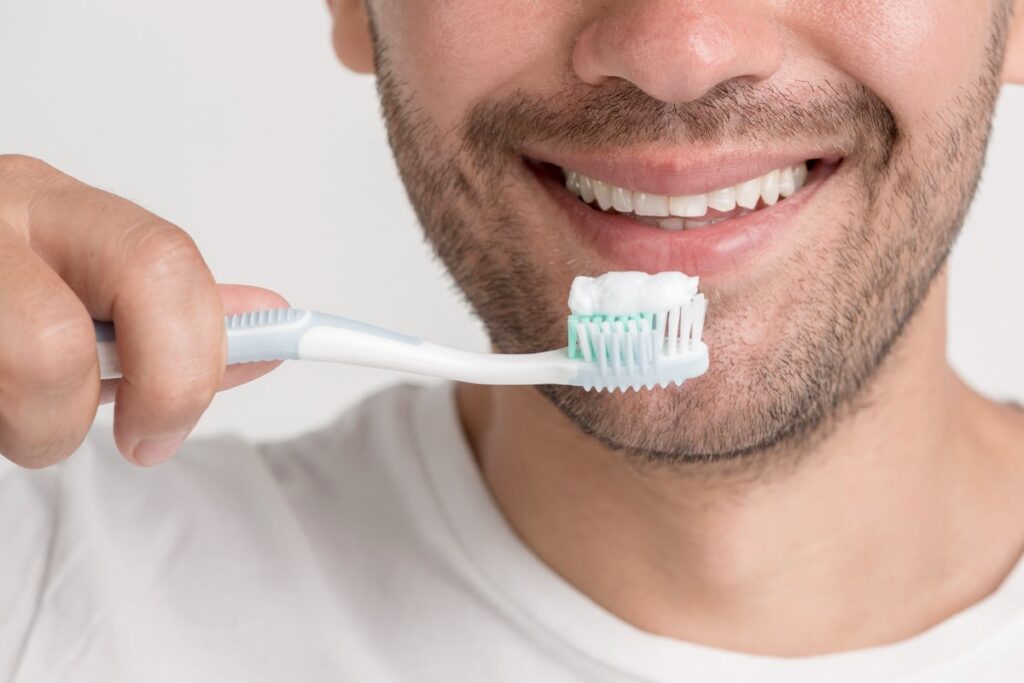
The best toothpaste for teeth whitening has a proven whitening active, like hydrogen peroxide or PAP, a safe abrasive level, and fluoride.
Whitening toothpaste can lighten surface stains from coffee, tea, wine, and smoking. It cannot bleach a tooth past its natural color, and it cannot fix stains that sit deep inside the tooth (American Dental Association, “Toothpastes,” ADA Oral Health Topics). It is simply what toothpaste, brushed for two minutes a day, is able to do.
If you just want the best whitening toothpaste without reading through every ingredient label, Colgate Optic White Advanced Sparkling White, Arm & Hammer Advance White, and Sensodyne Extra Whitening are widely considered good picks.
Below, we break down which ingredients actually lift stains, which ones just make teeth look whiter for a few hours, and which ones are not worth the money.
Table of Contents
ToggleHow Does Whitening Toothpaste Actually Work?
Most whitening toothpaste works one of three ways:
- A mild abrasive, like hydrated silica or baking soda, polishes surface stains off the tooth.
- A chemical active, like hydrogen peroxide or the newer ingredient PAP, breaks down stains instead of just scrubbing them off.
- An optical ingredient, like blue covarine or purple toothpaste, changes how light bounces off the tooth so it looks whiter right away (Joiner A, “Instant Tooth Whitening from a Silica Toothpaste Containing Blue Covarine,” peer-reviewed dental research, PubMed).
None of these reach stains that live inside the tooth. That kind of stain comes from aging, certain medications, or an old injury to the tooth, and it needs a peroxide gel or an in-office treatment to fade. Whitening toothpaste, at best, brings a tooth back to its own natural shade. It does not bleach past that point.
Does Whitening Toothpaste Actually Work?
Yes, and no, depending on the stain. Whitening toothpaste that works well removes surface stains from coffee, tea, red wine, and tobacco, as long as it has a real active ingredient behind the claim. It does not work on stains that sit inside the tooth, and it will not change the tooth’s true color. If a toothpaste promises dramatic, fast results, that promise is marketing, not chemistry. For a broader look at whitening options beyond toothpaste, see our guide on how to have white teeth.
Best Whitening Toothpaste, Recommended by a Dentist
Here are current picks for best toothpaste to whiten teeth, chosen for a real active ingredient, a safe RDA, and, where confirmed, the ADA Seal of Acceptance.
Product | Active ingredient | ADA Seal | Typical Price Range | Best for |
Colgate Optic White Advanced Sparkling White | 2% hydrogen peroxide | Yes, in the at-home tooth bleaching category | $6 to $9 | Coffee, tea, and tobacco stains |
Arm & Hammer Advance White (Baking Soda & Peroxide) | Baking soda plus peroxide | Arm & Hammer’s baking soda toothpaste line carries ADA acceptance | $4 to $6 | Mild, everyday whitening on a budget |
Sensodyne Extra Whitening | Potassium nitrate plus hydrated silica | Meets ADA, FDA, and ISO guidelines | $6 to $8 | Sensitive teeth |
But what is the best toothpaste for whitening teeth? Honestly, no single product works for every mouth. Choose Sensodyne for sensitivity, Arm & Hammer for steady low-risk maintenance, and Colgate Optic White for stronger coffee or tobacco stains.
Disclaimer: This is general education, not a recommendation or guarantee. Every patient is different, and only a personal evaluation with a dentist can determine what’s right for you. We are not affiliated with any of these brands. Our recommendations are based on ingredients and evidence, not compensation.
What to Look For: Ingredients, RDA, and the ADA Seal of Acceptance
This is the part most buying guides skip, and it decides whether a toothpaste does anything at all. The best toothpaste for whitening teeth should have:
- Hydrogen Peroxide: It breaks down surface stains chemically instead of just buffing them off. The ADA names it as the ingredient used to lighten stains.
- PAP: It’s a newer, peroxide-free active that can lighten stains with less sensitivity than peroxide. It has not been studied as long, so treat it as promising, not proven.
- Hydrated Silica: It’s the mild abrasive behind most whitening formulas. It is safe within the ADA and ISO RDA limit of 250 or below.
- Baking Soda (Sodium Bicarbonate): It’s a low-abrasivity ingredient the ADA recognizes for removing surface stains. It will not bleach past the tooth’s natural shade.
- Fluoride: The ADA Seal requires it, and it should never be traded away for a whitening claim.
- Potassium Nitrate or Stannous Fluoride: They calm nerve sensitivity, so whitening does not come with discomfort.
- Blue Covarine: It changes how light reflects off the tooth for an instant but temporary effect. It does not remove or prevent stains the way peroxide or silica do.
- Purple (Color-Correcting) Toothpaste: It works the same way as blue covarine. The effect rinses away and does not remove real stains.
- Sodium Lauryl Sulfate (SLS): It’s the foaming agent in toothpaste, unrelated to whitening. People prone to mouth irritation may prefer an SLS-free formula.
Any toothpaste at or below an RDA of 250 is considered safe for enamel and dentin, according to the ADA and ISO standards (source: ADA.org, “Toothpastes,” Oral Health Topics). Above that number, wear risk rises, especially with heavy daily use of high-abrasive or charcoal formulas.
Best Whitening Toothpaste for Yellow Teeth
Yellow teeth are usually a mix of two things: surface stain sitting on top of the tooth, and the tooth’s own dentin, which is naturally more yellow and shows through as enamel thins with age. A toothpaste with hydrogen peroxide or PAP can lift the surface stain part. It cannot change the color of the dentin underneath, so it is fair to expect real improvement, not a totally different shade.
Best Whitening Toothpaste for Smokers, Coffee, and Wine Stains
Tobacco, coffee, tea, and red wine all cause the same type of stain. They leave behind pigments called chromogens that cling to the outer tooth surface. For this kind of heavy surface stain, look for a toothpaste with a stronger abrasive level (still within the safe range) or a peroxide- or PAP-based formula, since these tackle stubborn stains better than a mild polish alone.
Best Whitening Toothpaste for Sensitive Teeth
If your teeth ache with hot, cold, or sweet foods, choose a whitening toothpaste built around potassium nitrate or stannous fluoride. Both calm the nerve inside the tooth so brushing does not come with daily discomfort. Some newer formulas use PAP instead of peroxide because it tends to cause less sensitivity, though it has not been studied for as many years as peroxide has.
Charcoal Whitening Toothpaste: Does It Whiten or Just Feel Abrasive?
Charcoal toothpaste is popular, but the evidence does not back it up. A 2017 review in the Journal of the American Dental Association looked at charcoal and charcoal-based toothpaste and found no reliable proof that it whitens teeth. Many charcoal formulas also have not been tested for how abrasive they are, so daily use could wear down enamel without you knowing it. If you like the idea of charcoal toothpaste, at least check that the brand publishes its abrasivity data first.
Natural and Enamel-Safe Whitening Toothpaste
Natural whitening toothpaste does not automatically mean gentle. Some natural abrasives, including baking soda and activated charcoal, sit near the higher end of the safe range for enamel wear, and not every trending ingredient, from coconut oil to essential oils to nano-hydroxyapatite, has the same evidence behind it.
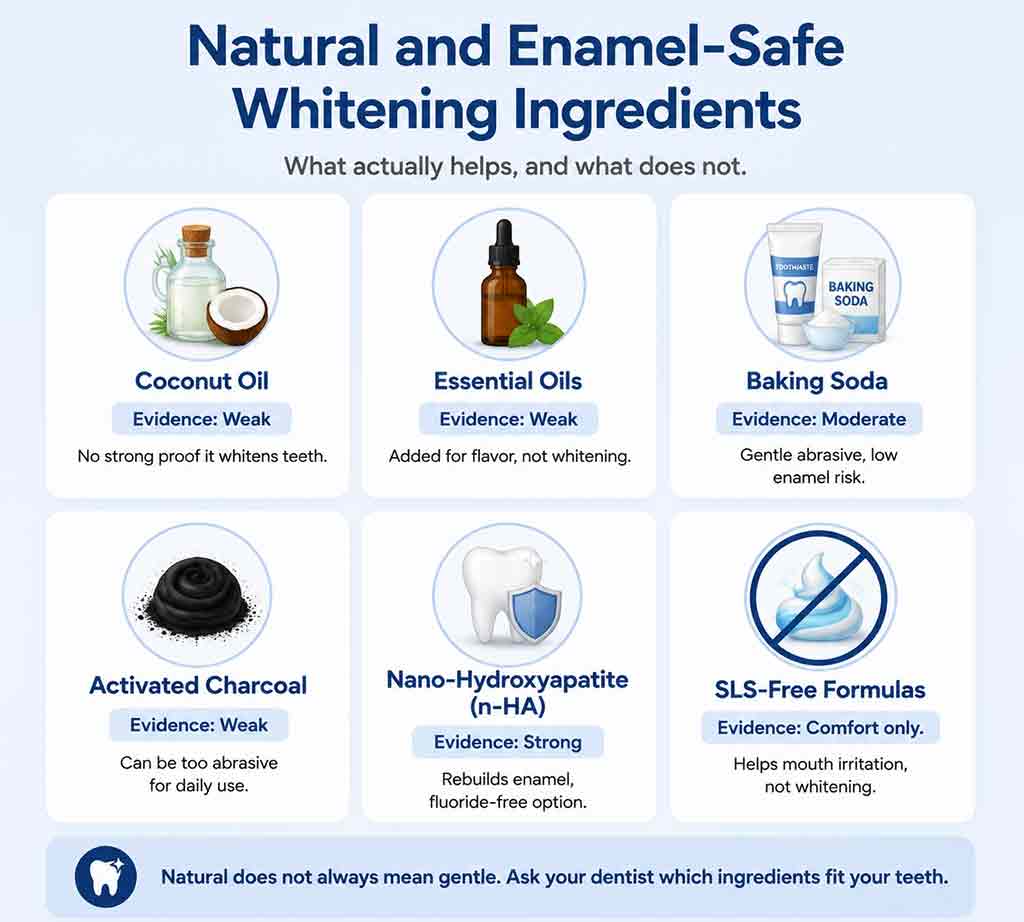
- Nano-hydroxyapatite (n-HA) is the closest thing to an evidence-backed non-fluoride option, and a reasonable choice for people who want to avoid fluoride.
- If foaming toothpaste bothers your mouth, look for one labeled SLS-free. It does not whiten teeth either way, so skipping it is about comfort, not results.
Tips for Getting the Most Out of Whitening Toothpaste
- Brush for the full two minutes, twice a day, rather than a quick pass.
- Wait a bit before rinsing with anything acidic, like coffee or orange juice, right after brushing.
- Use a straw for drinks that stain, such as coffee, tea, and red wine.
- Keep up with regular dental cleanings, since they remove buildup that toothpaste alone cannot reach.
How Long Does Whitening Toothpaste Take to Work?
Most whitening toothpaste needs 2 to 6 weeks of steady, twice-daily use before you notice a real difference, since it works gradually on surface stains rather than bleaching teeth in one sitting. Optical products like blue covarine and purple toothpaste are the exception. They change how teeth look right away, but that change washes off and does not build over time the way a true whitening ingredient does.
Common Mistakes to Avoid
- Brushing harder or more often than needed, hoping for faster results.
- Choosing a high-abrasive or charcoal toothpaste without checking its safety data.
- Expecting toothpaste to fix stains that sit inside the tooth.
- Mistaking a purple or blue-tinted toothpaste for real whitening, when the effect is only optical.
- Skipping regular cleanings and relying on toothpaste alone.
When to See a Dentist Instead
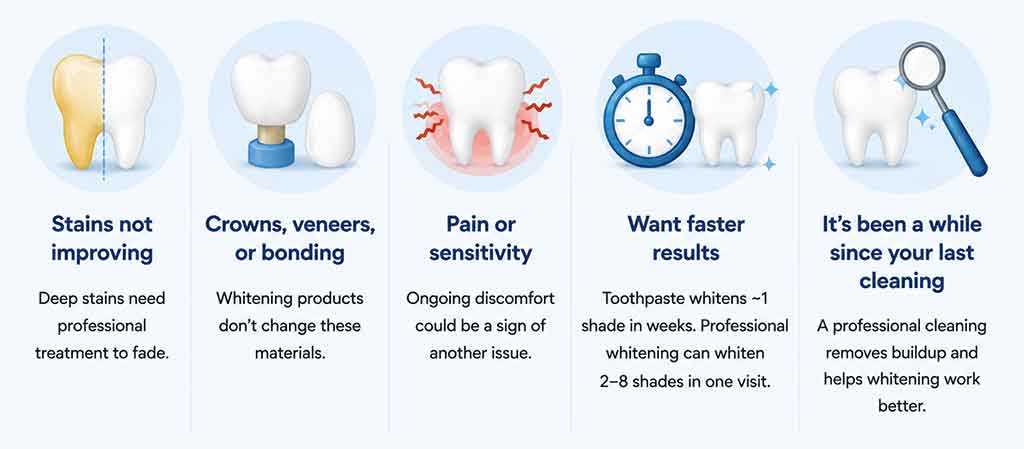
Whitening toothpaste has real limits, and there are times when it makes more sense to talk to a dentist.
Get a Brighter Smile at Kirkland Dental Excellence
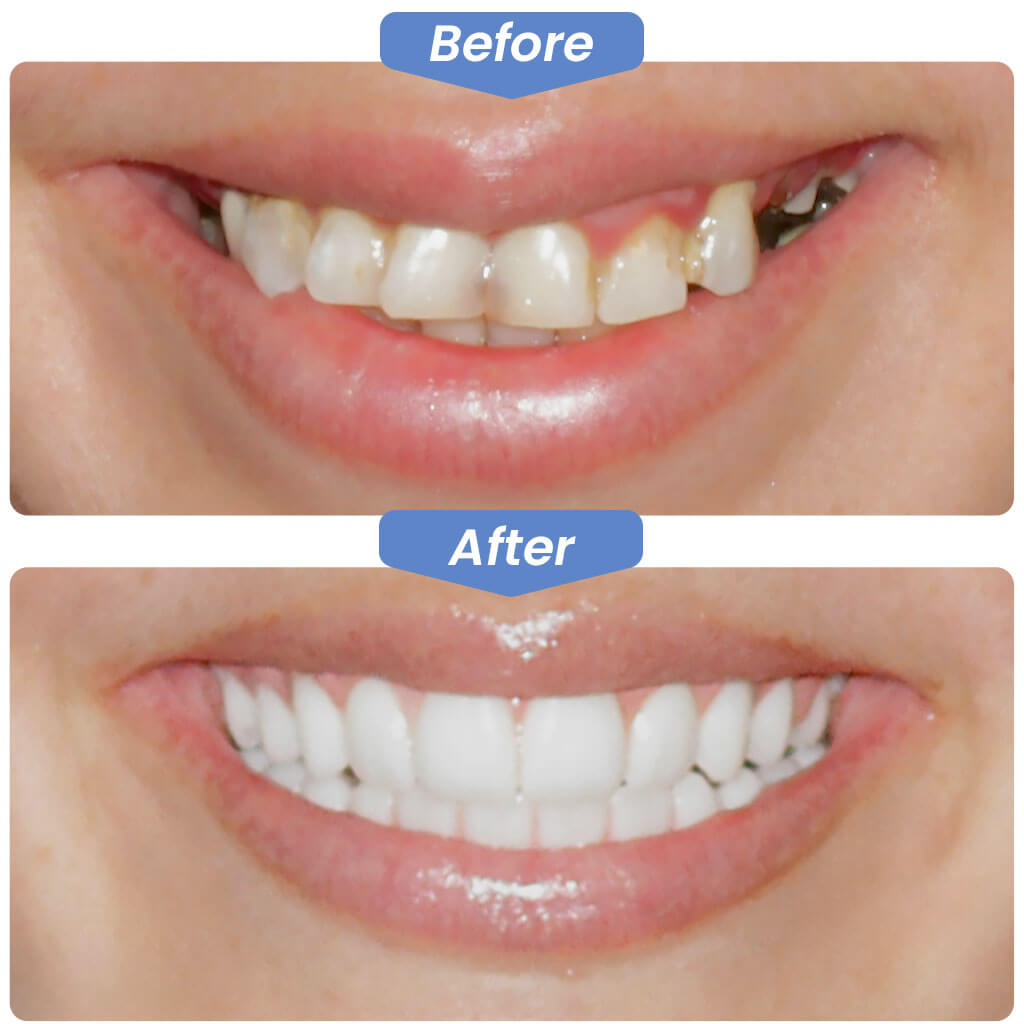
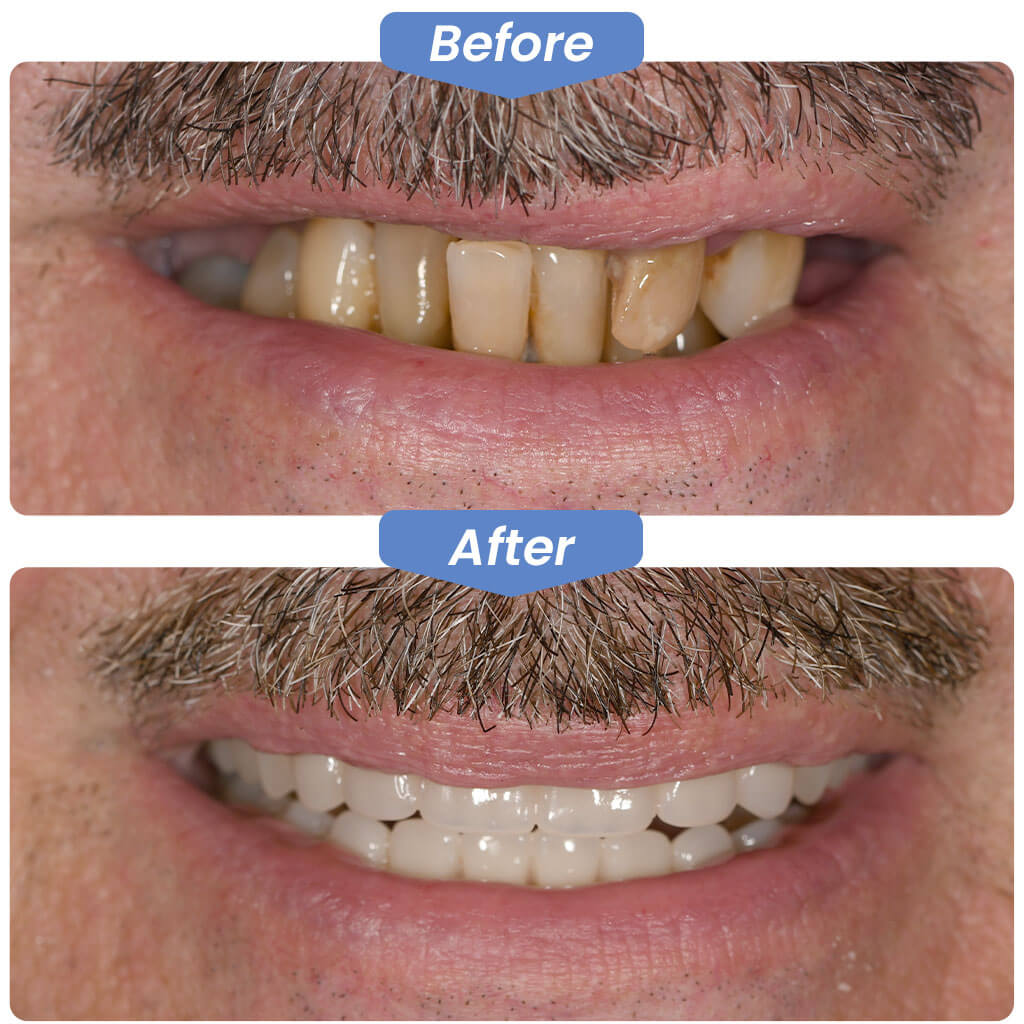
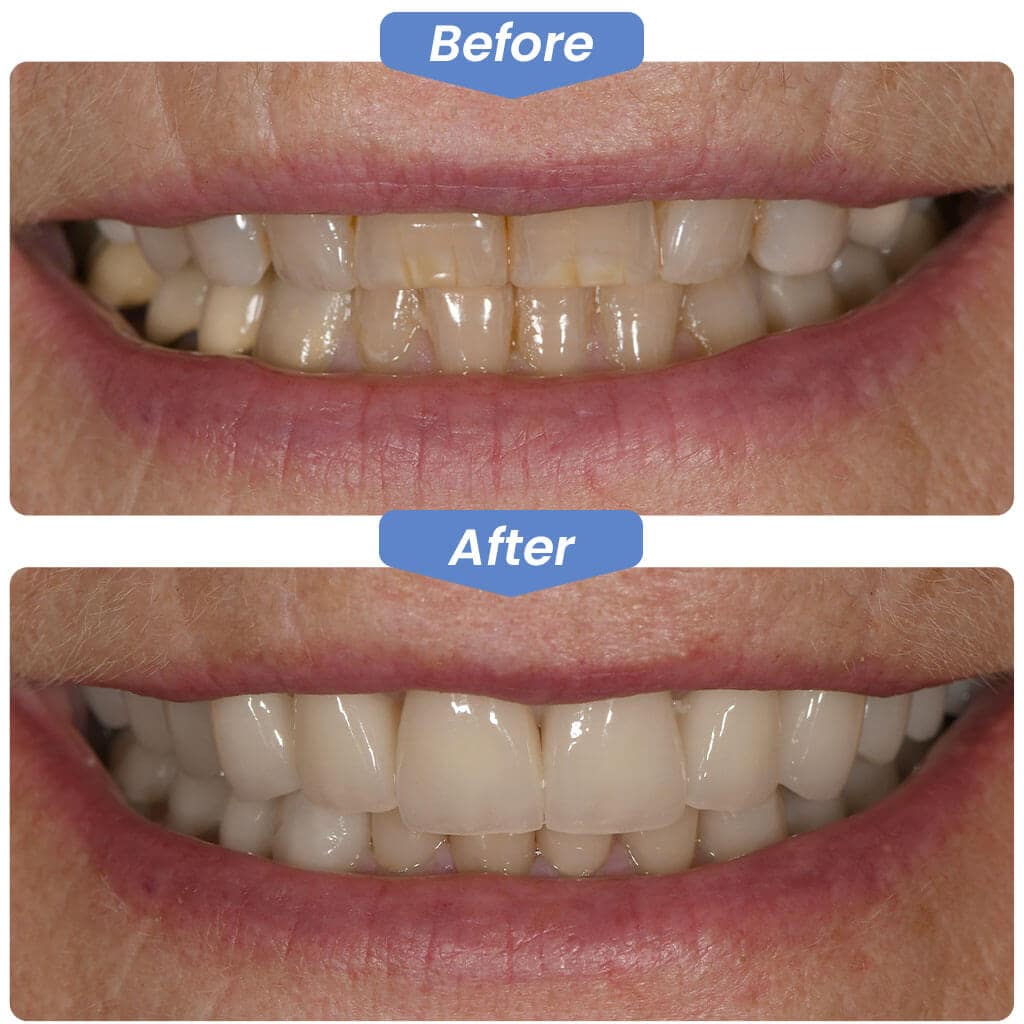
The best toothpaste for teeth whitening can lift surface stains, but it will not fix a stain that sits inside the tooth, and it will not tell you why your smile is not responding. Finding that out takes a real exam.
At Kirkland Dental Excellence in Kirkland, Dr. Hedayati-Zafarghandi checks your teeth, looks at what is actually causing the discoloration, and gives you an honest plan, whether that means professional teeth whitening or something else entirely.
We serve patients across Kirkland and the greater Seattle area with a focus on the option that fits your teeth, not a one-size-fits-all fix.
Call Kirkland Dental Excellence at (425) 827-2003 to get seen at 1619 Market St, Kirkland, WA 98033.
FAQs
Look for one with a proven active ingredient such as hydrogen peroxide, PAP, or hydrated silica, an RDA of 250 or below, fluoride, and ideally the ADA Seal of Acceptance.
It works on surface stains when the active ingredient is backed by real evidence. It does not work on stains inside the tooth, and it cannot change the tooth’s natural color.
Not if the RDA stays at or below 250. Risk goes up with high-abrasive or unregulated formulas, including some charcoal toothpastes used every day.
Yes, as long as it has a safe RDA and contains fluoride. Check the label or look for the ADA Seal rather than assuming.
It can for some people, especially with higher-abrasive or peroxide formulas. Toothpaste with potassium nitrate, stannous fluoride, or PAP is made to ease that.
With braces, yes, on the natural tooth surfaces. With veneers or crowns, whitening toothpaste will not change their color, so check with a dentist if you want an even shade.
Purple, or color-correcting, toothpaste works the same way as blue covarine. It uses pigment to cancel out yellow tones so teeth look whiter right after brushing. The effect is instant but temporary and rinses away. It does not remove or prevent real stains.
Whitening toothpaste is generally not recommended for young children. A standard fluoride toothpaste, at the amount your dentist recommends for their age, is the safer choice.